

A past that is still being uncovered
For more than 160 million years, dinosaurs ruled the Earth, adapting to different ecosystems and evolving in surprising ways. Although they went extinct approximately 66 million years ago, their story is far from complete.
Every fossil discovered represents a key piece in a puzzle that science continues to piece together.
What do fossils tell us?
Through the study of fossil remains, paleontology has enabled us to understand fundamental aspects of dinosaurs: their anatomy, diet, locomotion, and even possible social behaviors.
Fossilized footprints, skeletal remains, and preserved structures provide evidence that helps scientists formulate increasingly accurate hypotheses about how these species lived and how they interacted with their environment.
From research to experience
In recent decades, scientific knowledge has found new ways to be shared. It is no longer limited to specialized publications or academic settings.
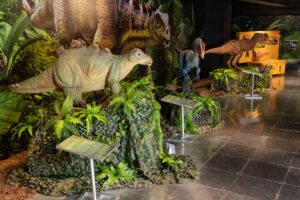
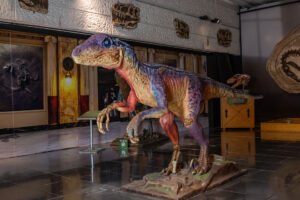
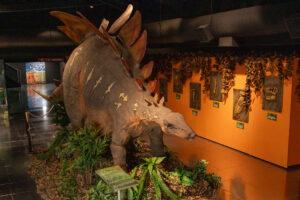
Today, technology makes it possible to translate complex information into accessible experiences. Through life-size models, detailed recreations, and motion systems, we can get a more tangible sense of what these prehistoric animals were like.
Understanding through experience
Watching a dynamic depiction of a dinosaur allows us to grasp aspects that text or images don’t always convey: proportions, posture, and physical presence.
This approach promotes understanding and sparks a deeper interest, especially among young audiences, making learning feel natural.
A link between the past and the present
The study of dinosaurs is not merely a matter of satisfying curiosity about the past. It also provides valuable insights into the evolution of life on Earth, climate change, and the dynamics of extinction.
Understanding its history allows us to better contextualize the present and reflect on the future of the planet.
Conclusion
Thanks to scientific advances, the world of dinosaurs continues to reveal new information. Today, more than ever, this knowledge can be explored in accessible and meaningful ways, bringing people closer to one of the most extraordinary chapters in natural history.